Deer mouse
The deer mouse (Peromyscus maniculatus) and its near-twin, the white-footed mouse (Peromyscus leucopus), are wild mice that live in fields, woodlots and around homes and cottages across southern Quebec. You can tell them apart from the house mouse by their pure white belly and feet, sharply two-toned tail and large eyes. Deer mice don't hibernate: as soon as autumn nights turn cold, they look for a heated shelter in attics, garages and walls. Their presence is never trivial, because the deer mouse is a known carrier of hantavirus.
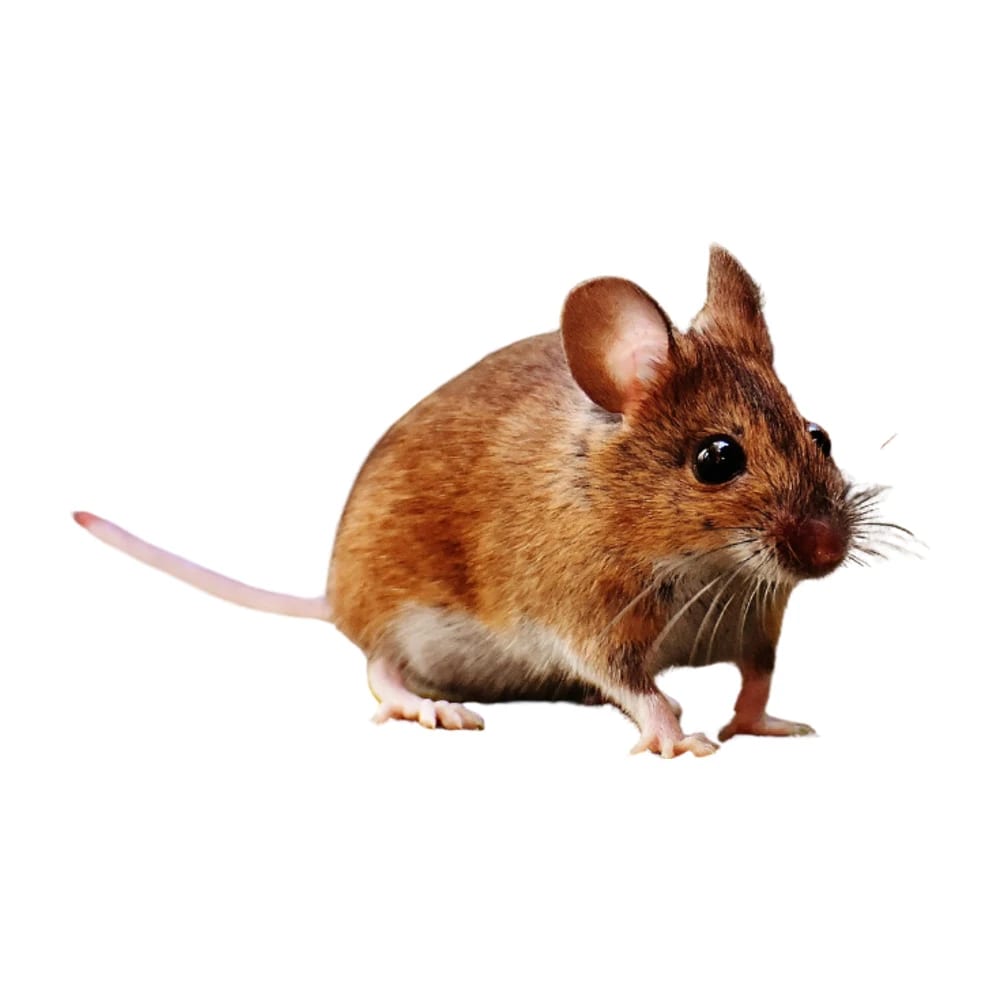
Appearance
- Small rodent about 15 to 20 cm long including the tail, weighing 15 to 25 g
- Brown to greyish-brown back in sharp contrast with a pure white belly and feet
- Furry, distinctly two-toned tail: dark on top, white underneath
- Large, bulging black eyes and big ears, more prominent than a house mouse’s
- Pointed muzzle with long whiskers
Behaviour
- Strictly nocturnal and rarely seen during the day
- An excellent climber and jumper that travels through walls, joists and attics
- Doesn’t hibernate and stays active all winter
- Moves indoors mainly in autumn, when nights get cold and food runs short outside
- Wary of people, but quickly returns to the same travel routes
Life cycle
- Lives mainly outdoors: fields, woodland edges, stone walls, sheds and outbuildings
- Several litters a year, from spring to autumn, with a few young in each
- Builds nests from shredded material: insulation, paper, fabric, plant fibre
- Stockpiles seeds in cavities, engines and storage spaces
- Squeezes through very small openings in foundations, soffits and around pipes
Diet
- Seeds, acorns, beechnuts and other nuts, which it carries off and stores
- Berries, buds and tender plant parts
- Insects, larvae and other invertebrates — an opportunistic omnivore
- Dry pantry foods: cereal, birdseed, pet kibble
- Table scraps and pet food left out
Deer mouse or white-footed mouse?
Two very similar species go by the same informal names in Quebec — "deer mouse," "field mouse" or, in French, mulot or souris sylvestre:
- the deer mouse (Peromyscus maniculatus);
- the white-footed mouse (Peromyscus leucopus).
Both live in southern Quebec and are almost impossible to tell apart without precise measurements. The good news: prevention and control are exactly the same for both. Voles are sometimes lumped in with them too, but a vole is a stocky rodent with a short tail and small ears that lives mostly in lawns and gardens, while a shrew, with its very pointed snout, isn't a rodent at all.
Deer mouse or house mouse?
| Deer mouse | House mouse | |
|---|---|---|
| Fur | Brown to greyish-brown back, pure white belly and feet, sharp dividing line | Uniform greyish-brown, greyish belly |
| Tail | Furry and clearly two-toned, dark above and white below | Nearly hairless, scaly, one colour |
| Eyes and ears | Large, bulging black eyes, broad ears | Smaller |
| Habits | Lives outdoors, moves in mainly in autumn; climbs and jumps | Lives in buildings year-round |
| Clues | Caches of seeds and acorns in drawers, boots, engines | Strong musky odour |
The droppings of both species look alike: small, dark and 3 to 6 mm long. Our guide to mouse droppings helps you identify them and gauge how big an infestation is. For the house mouse, see our mouse fact sheet.
Where deer mice settle
Deer mice live outdoors first: woodland edges, fields, stone walls, woodpiles, sheds. That makes homes next to fields or woods, suburban houses, cottages, trailers, garages and sheds the most exposed. They move in mostly from September to November, when nights cool down, through openings as small as 6 mm (¼ in) in foundations, soffits, vents and around pipes.
As skilled climbers, they settle in attics, where insulation makes a cosy nest, as well as wall voids, basements, storage drawers, stored mattresses and even the air filters of parked vehicles. Typical signs: scratching at night in the walls or ceiling, droppings along baseboards, shredded insulation, and seeds stashed in unexpected places. If the noise is coming from inside the walls, read our article on mice in walls.
Hantavirus: the real risk
According to the Public Health Agency of Canada, the deer mouse is one of the North American rodents known to carry hantavirus, along with the white-footed mouse. People are mainly infected by breathing in particles of droppings, urine or saliva that become airborne — for example when droppings are swept up or vacuumed — but also through contact with contaminated surfaces or food, or a bite. The risk in Canada is low, but the illness can be severe, even in healthy people. The riskiest situations: opening up a cottage, shed or outbuilding that has been closed all winter, and cleaning a contaminated attic or basement.
To clean up deer mouse droppings, the Agency recommends that you:
- wear rubber or plastic gloves and, in an enclosed space, an N95 respirator;
- never sweep or vacuum droppings or nests;
- spray droppings, nests and surrounding surfaces with a Health Canada-approved disinfectant or a mix of 1 part bleach to 9 parts water, then let it soak for 10 minutes;
- wipe up with paper towels or a damp mop, double-bag and seal everything, then wash your gloves before taking them off and wash your hands.
Full details are on the Government of Canada page Hantavirus: Spread, prevention and risks. If fever, muscle aches or breathing problems appear after a clean-up like this, see a doctor and mention the rodent exposure.
Keeping deer mice out
- Seal the building envelope: foundations, soffits, dryer vents, pipe and wire penetrations, the bottom of garage doors. Use materials rodents can't chew through (steel wool, metal mesh, flashing); spray foam alone won't hold. Our article on caulking against rodents shows where to look.
- Remove food: keep birdseed, pet food and dry goods in hard containers, and place bird feeders away from the house.
- Reduce shelter: raise firewood and keep it away from the walls, clear vegetation from the foundation, and keep the garage and shed tidy.
- Protect the cottage: before closing it for the winter, store bedding and clothing in airtight bins and leave no food behind.
For more practical tips, see our guide on how to get rid of mice.
WHEN TO CALL EXTERMINATEK
Call a professional when scratching keeps up at night in the walls or attic, when droppings reappear after you've cleaned, when insulation is contaminated, or when a cottage has been occupied by mice over the winter. Removing mice without sealing their way in almost always leads to a new infestation the following autumn.
During the inspection, an Exterminatek technician finds the entry points and nesting areas, which are often invisible to an untrained eye. The work combines sealing the entry points, placing capture devices in strategic spots and follow-up until activity stops. Learn more about our mouse control service, read about what a mouse exterminator costs or contact us for a quote.

Request a quote
Need help? We’re here!
A certified technician assesses your situation and proposes a treatment plan suited to it.