How to get rid of a marmot in your garden?
A mound of fresh dirt by the shed, lettuce chewed to the ground, a hole under the porch: a groundhog may have moved in. The animal itself is harmless, but it can wipe out a vegetable patch in a few days and undermine a slab or a deck with its burrows. Here is how to get rid of a marmot in your garden effectively and humanely: recognize the signs, discourage it with buried fencing and a few repellents, close the burrows at the right time and know when to hand the problem over to a professional.
Know the groundhog to keep it out
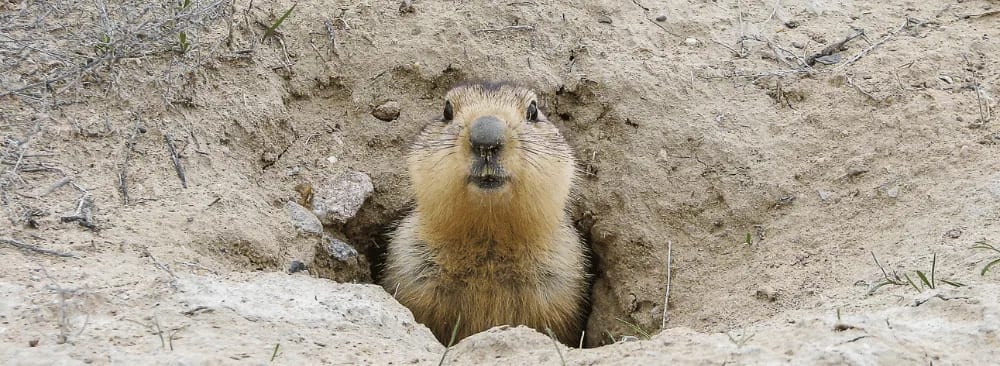
The groundhog (Marmota monax), also called a woodchuck, whistle-pig or simply marmot in Quebec, is a rodent in the squirrel family. It earns the “whistle-pig” nickname from the shrill whistle it gives when alarmed. It measures 40 to 65 cm in total length, with a short bushy tail, yellowish-brown to dark reddish-brown fur and short, powerful legs with strong digging claws. It usually weighs 2 to 4 kg, more in the fall before hibernation.
Groundhogs live throughout southern Quebec. They like fields, ditches and roadsides, but they are just as happy in residential yards, where they settle under decks, patios, sheds and garden structures. They prefer sandy, well-drained soil.
| Feature | Details |
|---|---|
| Active season | March to September–October |
| Hibernation | From the first frosts until March, with no food stored |
| Daily activity | Daytime, mostly early morning and late afternoon |
| Diet | Fresh greens: vegetables, flowers, clover, dandelions, bark in early spring |
| Reproduction | One litter a year of 3 to 4 young |
| Burrow | 2 to 5 entrances linked to several chambers; tunnels can exceed 15 metres |
How do I know if there is a groundhog in my garden?
- holes with large mounds of dirt, often along a fence, under a shed or at the edge of a wooded area;
- whole plants pulled out or clipped to the ground, half-eaten tomatoes;
- bark gnawed at the base of fruit or ornamental trees, especially in spring;
- the animal itself, feeding in the open near its burrow entrance and diving underground at the slightest noise.
Groundhogs live alone but are not territorial enough to keep others away: if you see one, there may be other burrows nearby.
Damage and risks caused by groundhogs

Your vegetable garden. A groundhog is a vegetarian with a big appetite and can eat more than a pound of greens a day. Lettuce, beans, peas, carrots, sunflowers and strawberries all go, often pulled up roots and all. Once it has found a good food source, it keeps coming back.
Your structures. By moving dozens of kilos of soil, a groundhog can undermine a slab, weaken the footings of a shed, deck or porch, disrupt drainage and speed up erosion on sloped lots.
Safety. A burrow entrance hidden in the grass is all it takes to twist an ankle while mowing. Children and pets face the same risk.
Health. Like other wild animals, groundhogs can carry ticks and fleas and, more rarely, transmissible diseases such as rabies. Transmission to people is rare, but avoid direct contact and keep an eye on pets that dig around burrows.
Fence the garden: the most durable fix
A well-built fence is still the best protection for a vegetable patch. Most failures come from mesh that is too short or laid at ground level: groundhogs climb and, above all, dig.
For gardens, the Quebec government recommends a metal mesh fence with openings no larger than 5 cm, built in three parts:
- a buried section of at least 25 to 30 cm, ideally 45 to 60 cm, which can be bent outward in an “L” so the animal hits mesh when it digs;
- an upright section of about 1 m;
- a top section of 30 to 45 cm, left unattached to the posts and leaning outward, so it wobbles when the groundhog tries to climb.
Use galvanized steel mesh rather than plastic, which a determined groundhog will chew through. For a small vegetable patch or raised beds, a mesh enclosure with a buried or bent-out base works very well. A single electric wire about 12 cm off the ground in front of the fence makes it even more effective, as long as vegetation does not touch it. Protect young tree trunks with a mesh cylinder.
The same buried, bent-out mesh is used to close off the space under a shed, porch or deck. It is the longest-lasting measure, ideally installed before the animal moves in.
Make your yard less inviting
Cut off the food supply
- pick up fallen fruit every day and harvest vegetables when they are ripe;
- use a closed compost bin and bury food scraps under dry leaves or soil;
- put a seed tray under bird feeders and clean up spilled seed;
- do not leave pet food outside and keep garbage bins tightly closed.
Remove hiding spots
Keep the grass short near buildings, clear away piles of wood, stones and debris that provide cover, and cut back dense vegetation along fences and sheds.
Plant what they avoid

Groundhogs avoid strongly scented or bitter plants. Border the vegetable patch with mint, lavender, basil, sage, rosemary, garlic or onions; marigolds and snapdragons can help too. It is not a fool-proof barrier, but it makes the spot less appealing.
Repellents and scare tactics
On their own, repellents give mixed results: every groundhog reacts differently and most get used to them within days. Combined with a fence and rotated regularly, they add another layer of protection.
- Cayenne or ground black pepper: sprinkle it around damaged areas, never on the edible parts of fruits and vegetables. Reapply after every rain.
- Predator and human scent: fox or coyote urine from a garden centre, or human hair in mesh bags near the burrows, can encourage it to move on. Refresh every two or three days.
- Homemade spray: castor oil mixed with water and a little dish soap, sprayed around the edge of the garden.
- Motion-activated sprinkler: one of the most effective tools, especially if you move it from time to time.
- Balloons, shiny CDs, fake owls: they work for a day or two at most.
Variety is the key: rotate scents and move devices so your yard stays unpredictable.
| Method | Effectiveness | Upkeep | Keep in mind |
|---|---|---|---|
| Buried mesh fence | High | Low | Best long-term solution |
| Raised-bed enclosure | High | Low | Ideal for small gardens |
| Motion-activated sprinkler | Medium to high | Medium | Move it regularly |
| Predator urine, human hair | Medium | High | Needs frequent refreshing |
| Pepper, garlic, castor oil | Low to medium | High | Washes off in the rain |
| Balloons, fake owls | Low | High | Groundhogs adapt quickly |
Close a burrow without trapping the animal
Once the groundhog is gone, an open burrow is an invitation for the next one, or for a skunk or a raccoon. Sealing it with an animal still inside, however, would be cruel. Work in this order:
- Check for activity. Loosely plug each entrance with leaves or crumpled newspaper. If nothing has moved after 48 hours, the burrow is probably empty. If the plug has been pushed out, someone is home.
- Pick the right time. In spring and early summer, young may be inside; in the fall, the animal is getting ready to hibernate. Late summer, once the young have left, is the safest window.
- Seal it. Fill the tunnel with gravel or soil, then cover the entrance with heavy mesh, burying the edges at least 30 cm deep. Under a shed or deck, install L-shaped mesh driven into the ground and bent outward.
Trapping and relocating a groundhog: what the rules say
Trapping should be a last resort, once prevention has failed. The Quebec government strongly discourages relocating wild animals far from where they were caught: moving them can spread diseases and parasites, and another animal will quickly take the vacant spot if the property is not protected. Depending on the region and species, relocation may even be prohibited. Read the government page on what to do if wild animals are on your property and check hunting and trapping rules before you capture anything.
If trapping is justified, use a live trap at least 75 cm (30 in.) long, baited with cantaloupe or apple slices and set near the burrow entrance. Check it morning and evening: a groundhog left in the sun can die of heat stress, and you might catch a skunk by mistake. Natural predators such as birds of prey also help, so avoid harming them.
When should you call a professional?
Buried fence, rotating repellents, and still a fresh hole every morning? It is time to call in help, especially if the burrows threaten a foundation, slab, porch or shed, or if you are not sure whether the burrow is occupied.
A technician can confirm that the burrow is in use, carry out a capture and relocation that complies with regulations, then seal the openings and install exclusion mesh so another animal does not take over. They will also pinpoint what drew the animal to your property: compost, hiding spots, openings under structures. Learn more about our pest control services for small mammals.
Frequently asked questions
What is the most effective way to keep groundhogs out of a garden?
A metal mesh fence with openings no larger than 5 cm, buried at least 25 to 30 cm and bent outward in an “L”, with a loose top that leans outward. Pair it with a motion-activated sprinkler and remove food sources.
What plants keep groundhogs away?
Strongly scented or bitter plants: mint, lavender, basil, sage, rosemary, garlic and onions, as well as marigolds and snapdragons. Planted around the vegetable patch, they make it less appealing, but they do not replace a fence.
Is it legal to trap and relocate a groundhog in Quebec?
The Quebec government strongly discourages relocation, and it may be prohibited depending on the region and species. Check the wildlife regulations before trapping, or leave the job to a professional.
How can I tell if a groundhog burrow is still active?
Loosely plug the entrance with leaves or newspaper. If the plug is untouched after 48 hours, the burrow is probably empty; if it has been pushed out, it is occupied. Never seal a burrow without this check.
Do compost and bird feeders attract groundhogs?
Yes. Open compost, fallen fruit, spilled seed and pet food left outside are strong attractants. A closed compost bin, a tray under feeders and picking up fruit daily make a real difference.
Groundhog moved in?
Burrow under the shed, a sinking slab, a ravaged vegetable garden? Our technicians work across Greater Montreal, from Laval to Longueuil. Call us at 514-677-7526 or request a quote.