Cluster Flies: Why Big, Slow Flies Gather on Your Windows in Fall
Every fall it’s the same story: big, slow, buzzing flies gather on your windows, in the attic or in a spare bedroom, then show up again on sunny winter afternoons. In almost every case, these are cluster flies. The good news: they don’t breed indoors and they have nothing to do with how clean your home is. The bad news: once they’re inside your walls, they’ll keep turning up all winter. This guide explains how to identify cluster flies, why they choose your house, what to do right now and how to keep them out next year.
What are cluster flies?
Cluster flies belong to the genus Pollenia, a group of flies in the blow fly family (Calliphoridae). They get their name from their habit of gathering in clusters on sun-warmed walls and in sheltered corners of buildings as the weather cools. In Quebec, they are most noticeable from late August to late October, then again during winter thaws and in early spring.
How to identify a cluster fly
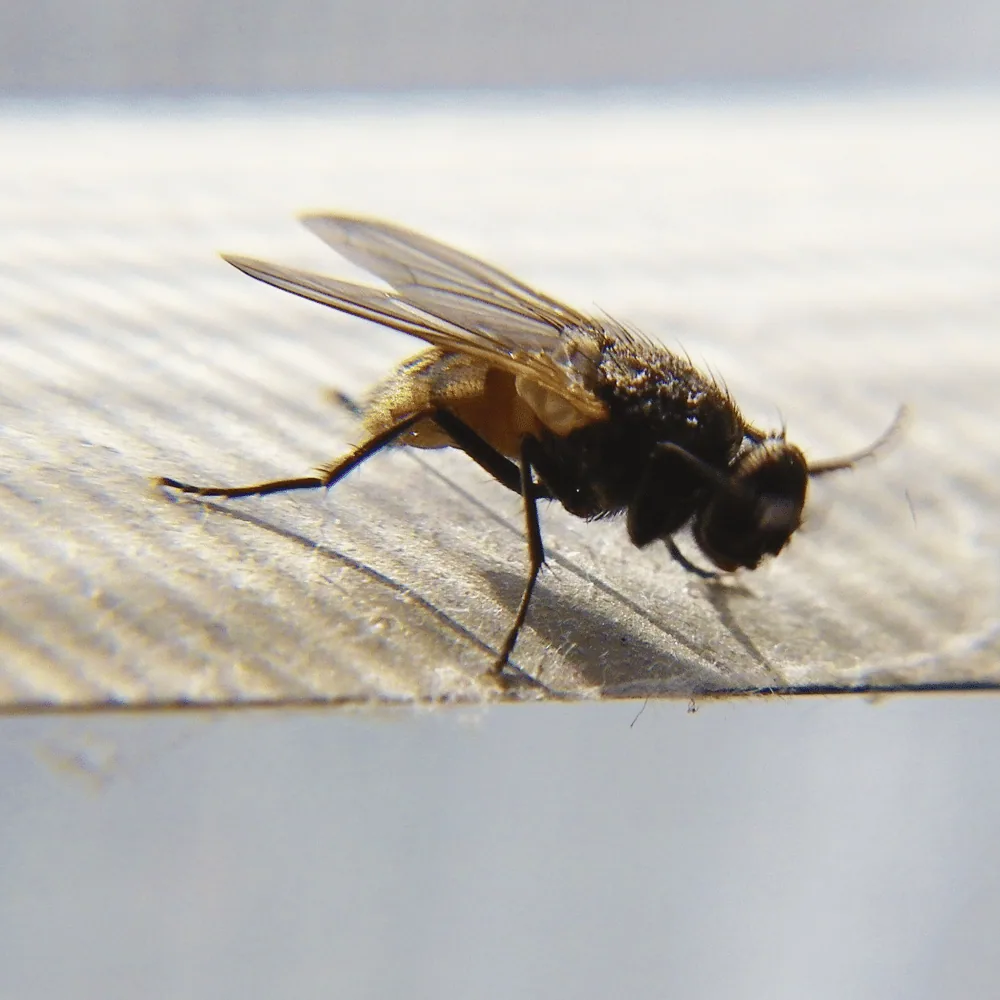
- Size: about 8 to 10 mm long, noticeably bigger than a house fly.
- Colour: dark grey, with a checkered silver-and-black abdomen that has no metallic sheen.
- Golden hairs: fine golden-yellow hairs cover the thorax (the upper body). They wear off with age but are often still visible under a magnifying glass.
- Wings: at rest, they fold flat over the back, one almost on top of the other. A house fly holds its wings slightly apart in a V.
- Behaviour: slow and clumsy, often found on their backs near windows. They buzz loudly when they fly and are easy to catch.
When crushed, a cluster fly leaves a stain and gives off a distinctive odour that many people compare to buckwheat. That’s one more reason to vacuum them up rather than swat them.
Cluster fly, house fly or blow fly?
Getting the identification right matters, because house flies and blow flies point to a breeding source you need to find, while cluster flies don’t.
| Cluster fly | House fly | Blow fly | |
|---|---|---|---|
| Size | 8 to 10 mm | 6 to 7 mm | 8 to 12 mm |
| Look | Grey, golden hairs on the thorax | Grey, four dark stripes on the thorax | Metallic green or blue |
| Season | Late summer, fall, winter thaws | Spring to fall | Mostly summer |
| Where you see it | Windows, attic, unused rooms | Kitchen, garbage, food | Near garbage or a carcass |
| Breeds indoors? | No | Yes, in organic waste | Yes, in meat or a dead animal |
If your flies are hovering around food and garbage, read our guide on how to get rid of flies in your home and our house fly identification sheet instead. Shiny metallic flies that suddenly appear in large numbers often point to a dead animal: see our article on blow flies. And for the tiny flies circling your fruit bowl, head to how to get rid of fruit flies.
A life cycle tied to earthworms
Here’s the detail that surprises most homeowners: the cluster fly larva is a parasite of earthworms. In spring and summer, females lay their eggs in the soil of lawns, fields and garden beds. The larvae burrow into earthworms, feed on them, then pupate in the soil before emerging as adults. Several generations follow one another over the warm season.
That life cycle explains three things:
- Cluster flies don’t breed in your home. No earthworms, no larvae. Health Canada confirms that they do not breed, feed or lay eggs inside homes.
- It isn’t a hygiene problem. A spotless home can host hundreds of them. They aren’t attracted to garbage or food.
- Houses surrounded by lawn get hit hardest. Suburbs, rural properties, large grassy lots: wherever earthworms thrive, so do cluster flies. Don’t try to fix the problem by reducing earthworms. They are vital to healthy soil, and it doesn’t work anyway.
Why do cluster flies gather on windows and in the attic?
In late summer, as the days get shorter, the last generation of adults looks for a place to spend the winter. In the wild, they squeeze under loose bark or into rock crevices. Near homes, they pick our walls.
What happens in the fall
On warm September and October days, cluster flies land in large numbers on south- and west-facing exterior walls, which soak up the sun’s heat. From there they probe every opening they can find: gaps around window frames, siding joints, soffits, fascia, and openings around pipes and wires. Once inside, they settle in the attic, wall voids, closets and cooler unused rooms.
Attic flies and winter wake-ups
The flies hidden in your walls go dormant. On a sunny January afternoon or during a March thaw, the warmth wakes them up. Disoriented, they head toward the light, but into your living space instead of back outside. That’s why you find them crowded on upstairs windows, around recessed light fixtures, or dead by the hundreds on the attic floor.
Cluster flies also tend to return to the same buildings year after year. Tall homes with good sun exposure, standing on a large lawn, are classic targets.
Are cluster flies harmful?
No. They don’t sting or bite, aren’t known to spread disease and don’t damage your home’s structure. The problems are mostly practical:
- the buzzing, and dozens or even hundreds of flies in a room;
- small dark spots (droppings) on windows, curtains and light-coloured walls;
- piles of dead flies in the attic and wall voids, which can attract scavengers such as larder beetles that later move on to natural fibres and stored food.
How to get rid of cluster flies indoors
Once cluster flies are in the walls, the goal is no longer to keep them out, but to remove them as they emerge and block their way into the rooms you live in.
What works
- A vacuum cleaner. The simplest, cleanest method. Vacuum the flies off windows and around light fixtures, then empty the bag or canister outdoors into a sealed bag. Do it promptly: dead flies in the bag attract other insects.
- Window sticky traps. These clear strips stick to the glass and catch flies drawn to the light. They are discreet and work well in rooms you don’t use much.
- Light traps in the attic. In a dark attic, an ultraviolet light trap catches flies as they wake up, before they make their way downstairs.
- Sealing from the inside. Find where they are getting into the room: window trim, baseboards, recessed lights, the attic hatch, outlets on exterior walls. A bead of caulk or a strip of weatherstripping keeps them from crawling from the wall void into the room.
What doesn’t work
- Bug bombs and indoor sprays. They kill the flies you can see, not the ones sleeping in the walls. Those keep emerging all winter, and the dead flies left in the cavities feed other insects. Over-the-counter products also carry risks for the people in the home: see our article on the dangers of over-the-counter insecticides.
- Sugar or vinegar bait traps. Cluster flies don’t feed indoors. Those traps work for house flies and fruit flies, not for them.
- Swatting. It stains walls and curtains and releases that odour.
- Treating your lawn for earthworms. Pointless, and bad for your yard.
Preventing cluster flies next year
Prevention happens before the end of August, before the flies start gathering on your walls.
Seal the entry points
Walk around the house, starting with the south and west sides:
- caulk around windows and doors, and replace worn weatherstripping;
- seal gaps in siding, fascia and roof edges;
- close openings around pipes, wires, outdoor outlets and air conditioners;
- install fine mesh over soffit and attic vents;
- repair or replace torn screens, including on upper-floor windows.
The same work protects your home from the other fall invaders looking for a place to overwinter in your walls, such as boxelder bugs, western conifer seed bugs and stink bugs, and Asian lady beetles.
Time the exterior treatment right
For homes that get hundreds of cluster flies every year, a professional treatment applied to sunny exterior walls is the natural complement to sealing. Timing is everything: it has to go on just before the flies start to cluster, in late summer. Penn State Extension notes that exterior treatments break down in sunlight, so applying too early wastes them, and applying too late means the flies are already in the walls. Our seasonal exterior spraying generally includes a second visit in August, right on time for fall invaders. Our article on seasonal pest dynamics in Quebec explains why these invasions come back at the same time every year.
When should you call an exterminator?
A few cluster flies on a window are easy to handle with a vacuum. Call a professional if:
- you’re removing dozens every day, or hundreds every fall;
- they invade bedrooms and living areas all winter long;
- you can’t find their entry points, or they are high up under the roofline or in the soffits;
- dead flies are piling up in the attic and you’re noticing other insects;
- you aren’t sure they’re really cluster flies and worry about a breeding source indoors.
A technician will confirm the species, locate the entry points, recommend sealing work and schedule an exterior treatment at the right point in the season.
Frequently asked questions
Why do cluster flies come back every winter?
They never really left. The flies that got into your walls in the fall sleep in the cavities and wake up every time a warm or sunny day heats the wall. Until that hidden population runs out, new flies will keep appearing until spring.
Do cluster flies lay eggs in the house?
No. Their larvae only develop inside earthworms, outdoors. The flies you see indoors are adults that came in to overwinter, not a new generation born in your home.
Where do the flies in my attic come from?
They get in through soffits, fascia, vents and siding joints in late summer, drawn by the warmth of sun-facing walls. A quiet, unheated attic is an ideal place to spend the winter.
Are cluster flies dangerous to kids or pets?
No. They don’t sting, bite or contaminate food. The real risk comes from insecticides misused indoors; a vacuum is still the safest solution.
When is the best time to prevent cluster flies?
Late summer. Sealing should be finished before the end of August, and any exterior treatment applied just before the flies start gathering on your walls, usually between late August and September.
Need help with cluster flies?
Big flies taking over your windows or attic every fall? Our technicians work across Greater Montreal, from Laval to Longueuil, to identify the insect, find its entry points and plan next season’s prevention. Learn about our pest control services, call us at 514-677-7526 or request a quote.