Wasp vs Bee vs Hornet: How to Tell Them Apart (and What to Do)
A yellow-and-black insect keeps buzzing around your patio table, or flying in and out of a crack in the siding. Wasp or bee? It’s more than idle curiosity. The answer tells you how likely you are to get stung, how to react and who to call: an exterminator for a wasp nest, a beekeeper for a honeybee swarm. This guide shows you how to tell wasps vs bees vs hornets apart in a few seconds, how to recognize their nests and when it’s time to act.
Wasp vs bee: the key differences at a glance
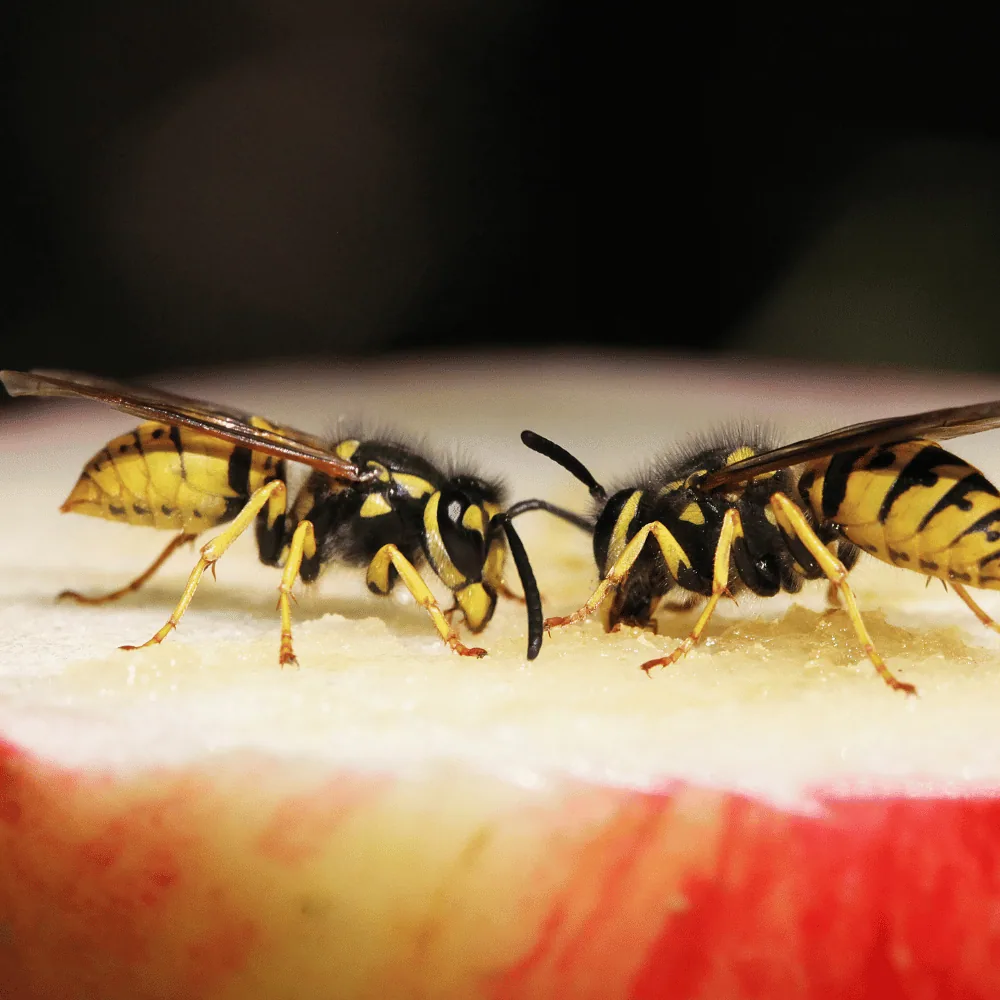
The simplest rule: bees are fuzzy and stocky, wasps are smooth with a narrow waist. Bees need hair to carry pollen; wasps are hunters with sleek, shiny bodies.
| Bee (honeybee, bumblebee) | Wasp (yellowjacket, paper wasp) | Hornet (European hornet, bald-faced hornet) | |
|---|---|---|---|
| Body | Stocky, rounded | Slender, elongated | Large and heavy-set |
| Hair | Very hairy, fuzzy look | Nearly hairless, shiny | Sparse hair |
| Waist | Barely visible | Very narrow “wasp waist” | Narrow |
| Colour | Golden brown and black (honeybee), fuzzy black and yellow (bumblebee) | Bright yellow and black, high contrast | Reddish brown and yellow (European), black and ivory white (bald-faced) |
| Length | 10 to 15 mm (honeybee), up to 25 mm (bumblebee queen) | About 10 to 20 mm | 15 to 35 mm depending on species |
| Legs in flight | Tucked in, often loaded with pollen | Dangling (paper wasps) | Dangling |
| Nest | Wax combs (honeybee), small nest in the ground or insulation (bumblebee) | Grey papery material made from chewed wood fibre | Paper, often very large |
| Nest location | Hive, hollow tree, wall cavity; old rodent burrow (bumblebee) | Under eaves, in the ground, wall voids, sheds | Trees, shrubs, eaves, cavities |
| Aggressiveness | Low, stings mainly in self-defence | Defends its nest; pushy in late summer | Defends its nest vigorously |
| Sting | Honeybees sting once and die; bumblebees can sting more than once | Can sting repeatedly | Can sting repeatedly |
| Diet | Nectar and pollen only | Insects for the larvae; sugar, fruit and meat for adults | Insects; sap and ripe fruit |
As Health Canada points out, unlike bees, wasps can sting more than once. A honeybee’s stinger is barbed: it stays lodged in the skin and the bee dies after stinging. A wasp’s stinger is smooth, so it can sting again and again.
A quick trick: watch what it eats
An insect working flowers, with balls of pollen on its hind legs, is almost certainly a bee or a bumblebee. An insect diving into your pop can, landing on the burgers or digging through the garbage is a wasp. In late summer, yellowjackets actively hunt for sugar and protein, which makes them far more persistent around outdoor meals.
The species you’ll meet in Quebec
Yellowjackets
Yellowjackets cause most stings. These wasps (genera Vespula and Dolichovespula), including the German yellowjacket, measure 10 to 16 mm and have a bright yellow abdomen banded with black. They build an enclosed grey paper nest with a single entrance hole, often in the ground, inside a wall void or under the eaves. By late summer, a colony can number in the thousands. For a full description, see our wasp identification sheet.
Paper wasps
Slimmer, with long legs that dangle in flight, paper wasps (Polistes) build an open, umbrella-shaped nest with exposed cells, hanging from a short stalk under a railing, an eave or a barbecue cover. Their colonies are small and they are less defensive than yellowjackets, but they will sting if the nest is disturbed.
The European hornet
The European hornet (Vespa crabro) is the only true hornet you’re likely to see here. It occurs in southern Quebec but is much less common than yellowjackets. Look for its large size (up to 35 mm for a queen) and its reddish-brown and yellow colouring. It nests in cavities: hollow trees, walls, attics. Unusually, it is also active at dusk and can be drawn to outdoor lights. The Asian hornet is not established in Quebec.
The bald-faced hornet
What most Quebecers call a “hornet” is actually a large wasp, Dolichovespula maculata. Black with ivory-white markings on the face and the tip of the abdomen, it measures about 15 to 20 mm. It builds the big grey, football-shaped paper nest you see hanging in trees or under eaves, and defends it aggressively. See our hornet identification sheet for more details.
Honeybees
The honeybee (Apis mellifera) is golden brown and black, hairy and 12 to 15 mm long. In Quebec, it almost always lives in beekeepers’ hives. When a colony gets crowded, part of it leaves the hive with a queen: this is called swarming. The swarm settles in a cluster on a branch, a fence or a wall while it looks for a new home.
Bumblebees
Big, round, very fuzzy and banded black and yellow, bumblebees are gentle pollinators. They live in small colonies of a few dozen to a few hundred, in an old rodent burrow, under a deck, in a compost pile or in the insulation of a shed. They can sting more than once but rarely do.
Solitary bees and potter wasps
Quebec is home to many species of solitary bees (mining bees, leafcutter bees, mason bees) that dig small holes in the ground or nest in hollow stems. They don’t form colonies and almost never sting. The same goes for the potter wasp, a solitary wasp that builds small clay pots on walls: it isn’t aggressive and needs no treatment.
Wasp nest or bee nest? How to tell
The nest is often easier to identify than the insect itself.
- A closed grey paper ball with a hole near the bottom: yellowjackets or bald-faced hornets. The paper, made of chewed wood fibre, forms wavy layers.
- A small open nest with visible cells, hanging from a stalk: paper wasps.
- A hole in the ground with constant traffic: often yellowjackets. If the insects are big, fuzzy and slow, they’re more likely bumblebees.
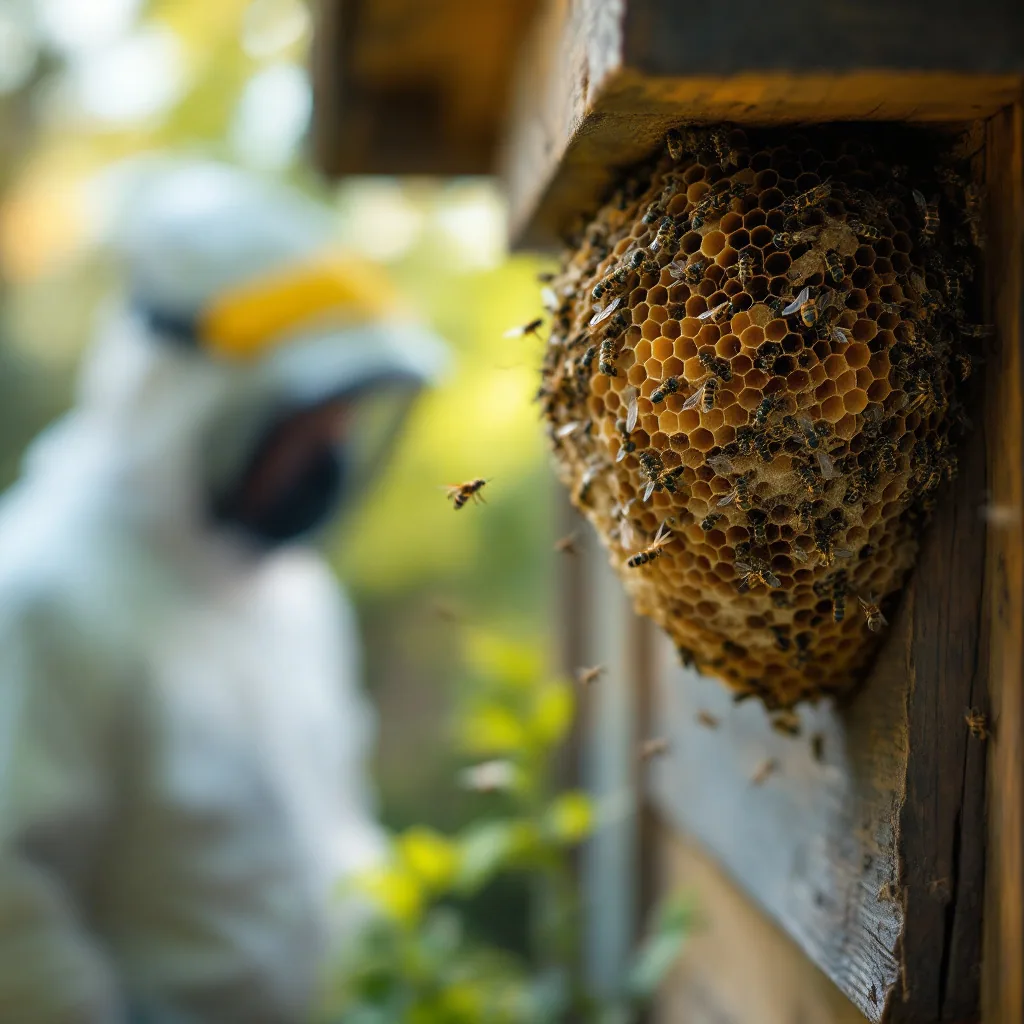
- Yellowish hexagonal wax combs in a hollow tree or wall: honeybees. A smell of wax or honey, or drips on the wall, are further clues.
- A tight cluster of bees on a branch, with no comb: a passing swarm. It usually moves on by itself within a few hours to a few days.
- Small pots or tubes of dried mud: a potter wasp or another solitary wasp.
Wasp nests are never reused. In late fall, the workers die and only the newly mated queens survive the winter, sheltering elsewhere. An empty nest you discover in November is no longer a threat.
Why bees shouldn’t be exterminated
Bees and bumblebees are essential pollinators for gardens, orchards and crops. Their decline worries beekeepers and farmers alike, and a honeybee swarm often belongs to a beekeeper in the neighbourhood. In fact, Quebec requires every beehive to be registered with the provincial agriculture ministry (MAPAQ).
What to do in each situation:
- A swarm on a branch or fence: keep your distance, keep children and pets away and don’t spray it with water. A swarm is usually not very defensive, since it has no nest or food stores to protect yet. Contact a local beekeeper, who can often collect it. Quebec’s beekeepers’ association, Les Apiculteurs et Apicultrices du Québec (site in French), explains how to get help finding an available beekeeper in your region; availability isn’t guaranteed and fees may apply.
- A bumblebee nest away from busy areas: leave it alone. The colony dies off in the fall and the nest isn’t reused.
- Honeybees living inside a wall or roof: this is trickier. The wax combs and honey have to be removed, or they’ll melt, seep through the wall and attract other insects. Call a beekeeper first, then a professional for the repairs and sealing.
When a wasp or hornet nest needs a professional
Not every wasp is a problem. A small paper wasp nest at the back of the yard, away from the paths, can often be left until fall. Health Canada nonetheless recommends professional help to remove an active nest, especially when:
- the nest is near a door, deck, pool, play structure or busy walkway;
- someone in the household is allergic to stings;
- the nest is inside a wall, the attic, the ground or another enclosed space where you can’t see how big it is;
- the nest is high up and you’d need a ladder;
- it’s a large bald-faced hornet nest or a European hornet nest;
- you’re seeing wasps inside the house.
Above all, never plug the entrance of an active nest in a wall: the wasps will look for another way out, sometimes into your home. Don’t blast a nest with the garden hose or try to burn it either. We cover the safe methods, and the ones to avoid, in our guide on how to deal with a wasp nest.
Our wasp extermination service uses the right protective equipment to eliminate the colony and remove the nest safely. As a guide, removing a wasp or hornet nest generally costs between $150 and $450, depending on location and access: see the details in our article on how much an exterminator costs.
If you get stung
- Bee: remove the stinger quickly by scraping it out with a fingernail or a card, without pinching it.
- Wasp or hornet: walk calmly away from the nest, since others may follow.
- Wash the area with soap and water and apply something cold to reduce swelling.
- Call 911 if there is any trouble breathing, swelling of the face, lips or throat, dizziness or hives all over the body. If an epinephrine auto-injector has been prescribed, use it right away.
Frequently asked questions
How can I tell a wasp from a bee?
Look at the hair and the waist. A bee is fuzzy, stocky and golden brown; a wasp is smooth, shiny, bright yellow and black, with a very narrow waist between the thorax and abdomen. Bees visit flowers, while wasps go after your sweet drinks and meat.
What’s the difference between a wasp and a hornet?
In Quebec, “hornet” usually refers to the bald-faced hornet, which is actually a large black-and-white wasp, and more rarely to the European hornet, a true hornet coloured reddish brown and yellow. Hornets are bigger than yellowjackets and defend their nests more aggressively.
Can a bee sting more than once?
A honeybee stings only once: its barbed stinger stays in the skin and the bee dies. Bumblebees have a smooth stinger and can sting more than once, like wasps and hornets, but they rarely do.
What should I do if a bee swarm lands on my property?
Keep your distance and leave it alone. A swarm often moves on by itself within a few hours to a few days. If it stays, or moves into a wall, contact a local beekeeper who can collect it.
Do wasps reuse their nest the following year?
No. The colony dies in the fall and only the new queens overwinter, elsewhere. An empty nest won’t be reoccupied, but the spot may attract a new queen in spring, so seal any openings once the nest is inactive.
Need help with a wasp nest?
Found a wasp or hornet nest near your home? Don’t take chances. Our technicians work across Greater Montreal, from Laval to Longueuil. Learn about our wasp extermination service, call us at 514-677-7526 or request a quote.